Research
Our research group designs new deep learning algorithms that are reliable from first principles.
The fundamental problem of scientific progress, and a fundamental one of everyday life, is that of learning from experience. — Sir Harold Jeffreys
What we learn from experience depends on the kind of philosophy we bring to experience. — C. S. Lewis
Deep learning is profoundly transforming the way we acquire knowledge and make decisions. It has tremendous potential to help us make better predictions through effective use of data. Yet deep neural networks still struggle with fundamental issues such as alignment with human intent, reliable operation over long durations, and continual adaptation to changing circumstances.
Our research group develops new methods for designing and understanding deep learning algorithms through the perspective of probabilistic modeling. Since probability theory describes the rules of optimal reasoning with incomplete information, it is a powerful tool for both identifying the limitations of deep neural networks and improving their capabilities. Our work applies insights from Bayesian probability and cognitive science to design deep learning algorithms that can truly be depended on to aid human understanding and decision-making in engineering, scientific, and societal applications.
1.) Stronger generalization to new environments
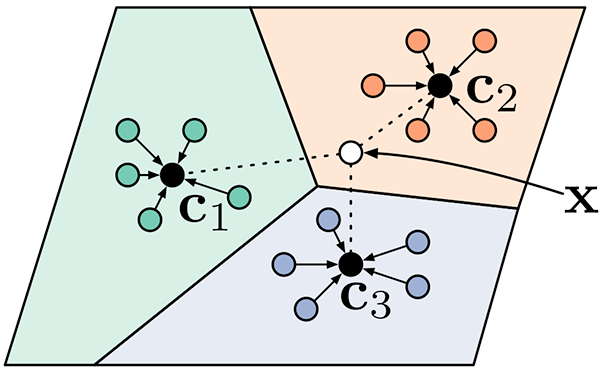
How can we build deep learning algorithms that adapt to new environments in an automatic and continuous way? Although deep neural networks are extremely flexible, the algorithms for training deep learning systems are surprisingly limited in scope. This inevitably leads to deep learning systems that make decisions under an illusion of certainty, with outcomes ranging from emotional distress to loss of human life. We use a paradigm called meta-learning to design new ways for neural networks to handle uncertainty better and act more adaptively in unfamiliar environments.
Representative publications:
- Snell, J., Bencomo, G., & Griffiths, T. (2024). A Metalearned Neural Circuit for Nonparametric Bayesian Inference. Neural Information Processing Systems (NeurIPS).
- Snell, J., & Zemel, R. (2021). Bayesian Few-Shot Classification With One-vs-Each Pólya-Gamma Augmented Gaussian Processes. International Conference on Learning Representations (ICLR).
- Snell, J., Swersky, K., & Zemel, R. (2017). Prototypical Networks for Few-Shot Learning. Neural Information Processing Systems (NeurIPS).
2.) Rigorous reliability verification with probabilistic inference
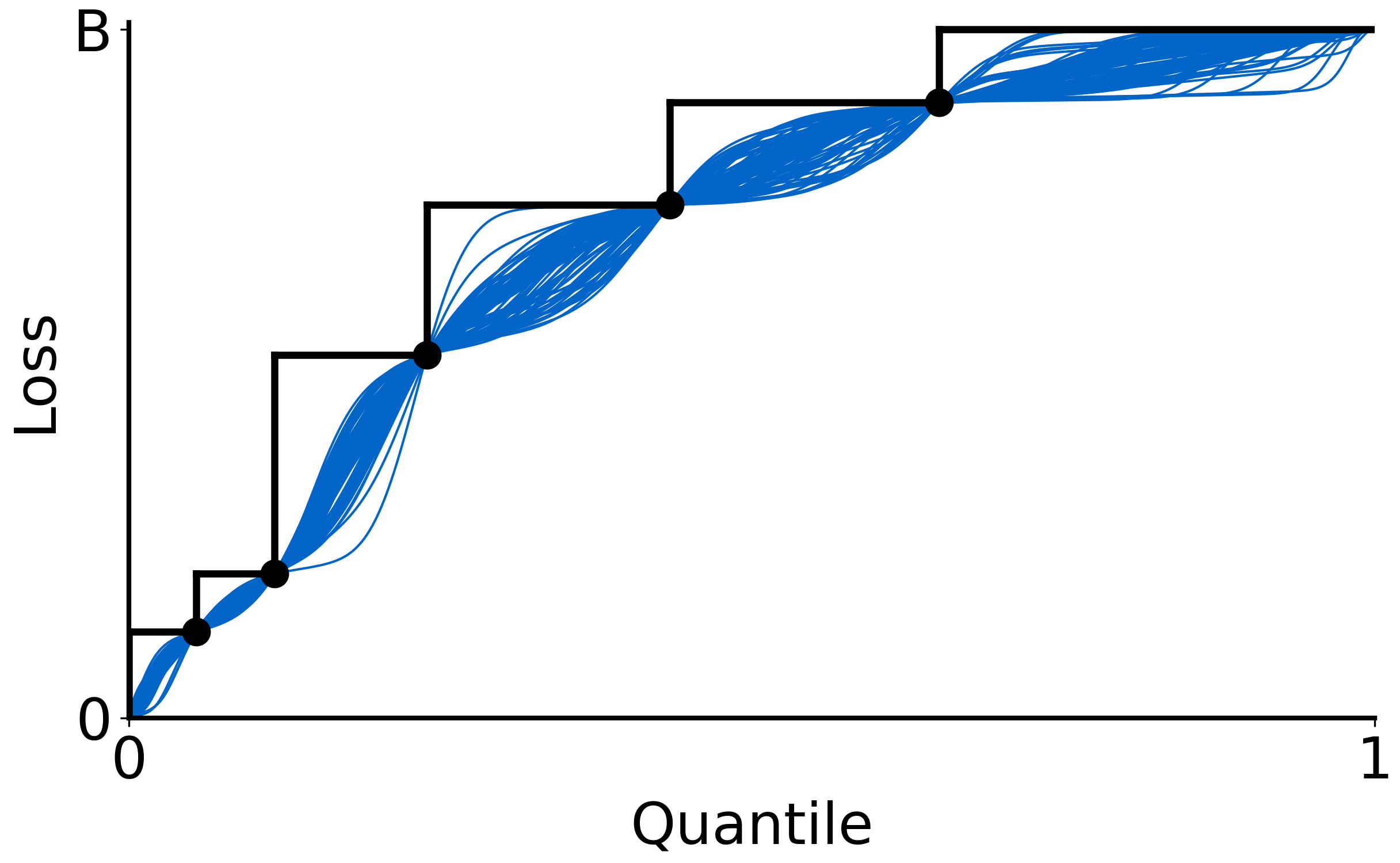
How can we rely on the outputs of neural networks to confidently make decisions in high-stakes applications? Modern large-scale models contain billions of parameters and are trained on vast amounts of data. This inherent complexity makes it difficult to directly verify the reliability of deep learning systems. Instead, we develop procedures that characterize the reliability of neural networks via guarantees grounded in probabilistic inference. Probabilistic models are well-positioned to incorporate external knowledge and produce meaningful inferential statements even with small amounts of data. This is especially promising in applications such as robotics and healthcare where reliability is absolutely essential, yet data is scarce in edge cases.
Representative publications:
- Snell, J., & Griffiths, T. (2025). Conformal Prediction as Bayesian Quadrature. International Conference on Machine Learning (ICML).
- Zollo, T., Morrill, T., Deng, Z., Snell, J., Pitassi, T., & Zemel, R. (2024). Prompt Risk Control: A Rigorous Framework for Responsible Deployment of Large Language Models. International Conference on Learning Representations (ICLR).
- Snell, J., Zollo, T., Deng, Z., Pitassi, T., & Zemel, R. (2023). Quantile Risk Control: A Flexible Framework for Bounding the Probability of High-Loss Predictions. International Conference on Learning Representations (ICLR).
3.) Discovery of implicit biases in black-box systems
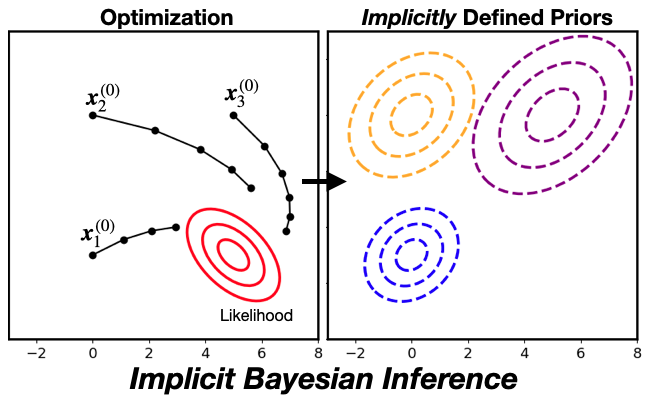
Large-scale deep learning models have billions of parameters and are trained on datasets hidden from the public. This inherent complexity means that such models often exhibit implicit biases even when they are trained to be fair and unbiased. We leverage the perspective of Bayesian probability to identify the implicit prior information that drives the behavior of deep learning models. By uncovering this information, we build new ways to transparently control AI so that it serves the needs of all users.
Representative publications:
- Liu, G., Snell, J., Griffiths, T., & Dubey, R. (2025). Binary Climate Data Visuals Amplify Perceived Impact of Climate Change. Nature Human Behaviour.
- Bencomo, G., Snell, J., & Griffiths, T. (2024). Implicit Maximum a Posteriori Filtering via Adaptive Optimization. International Conference on Learning Representations (ICLR).
Interested in this work?
Our group is recruiting PhD and Master's students.